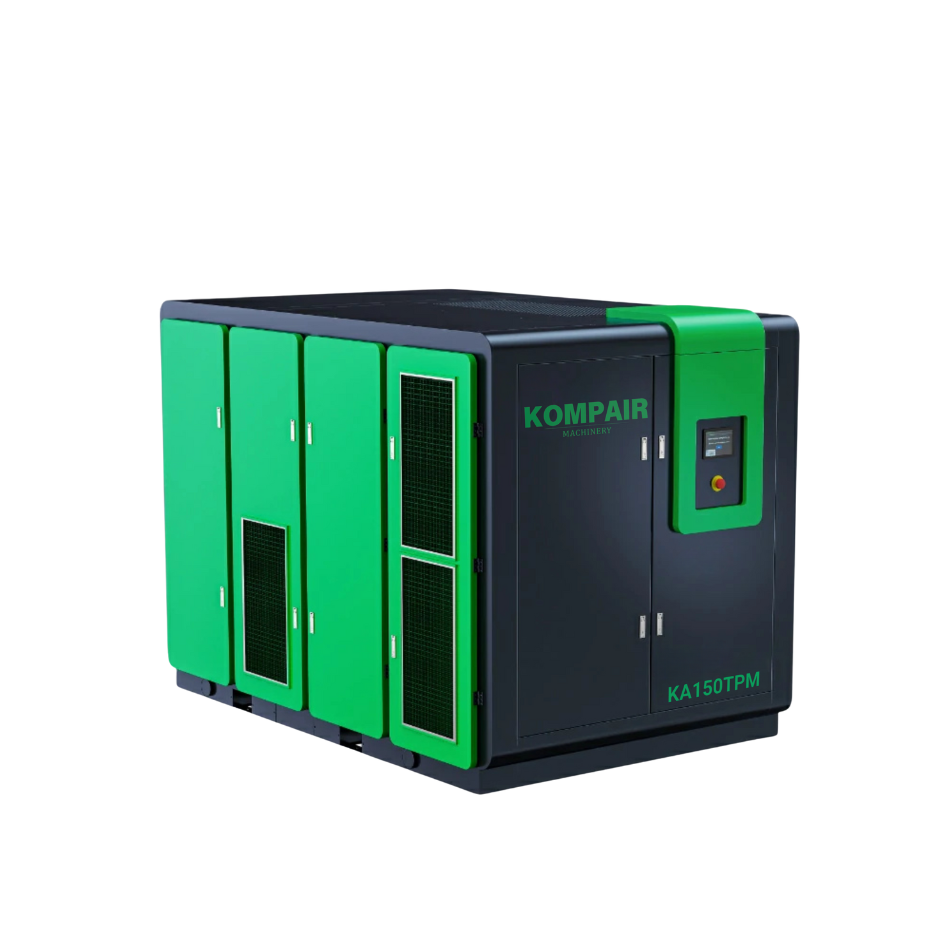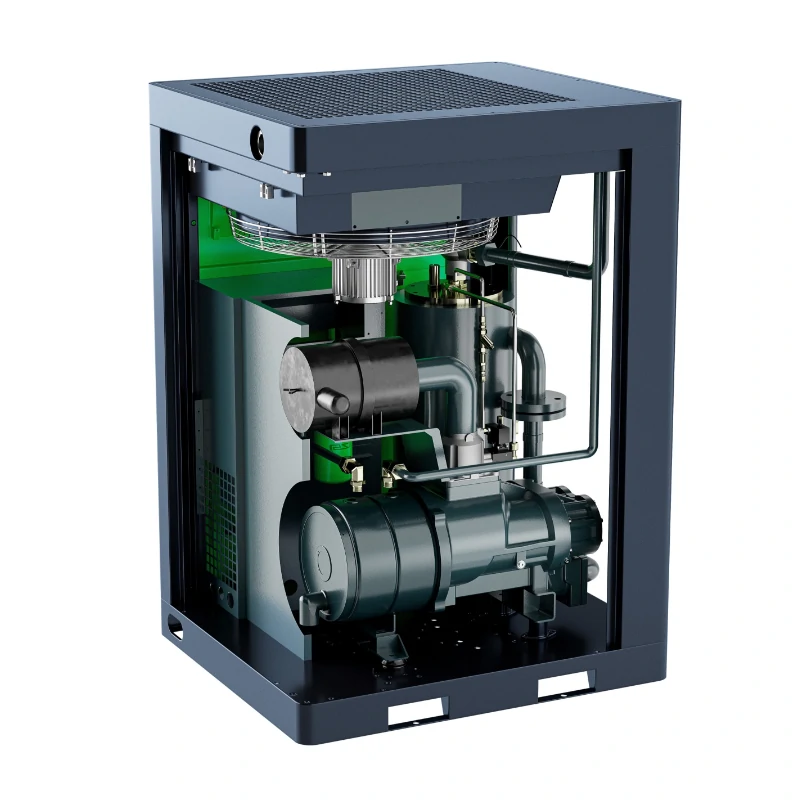
The decision to purchase an air compressor with or without an Inverter directly impacts its suitability for your factory’s production needs. To provide you with a comprehensive overview, facilitate the right choice, and ensure cost savings, let’s explore the features of each product through an analysis of their respective advantages and disadvantages below:
Inverter Air Compressor (Variable Speed Drive – VSD)
 Advantages:
- Low starting current.
- Load control based on the factory’s actual load requirements at any given time.
- Utilizes a Permanent Magnet Motor (IPM), IE4 efficiency class, Class H insulation, and oil-cooling (liquid-cooled).
- The motor and rotor are directly coupled (direct drive), eliminating the need for couplings, belts, or gears, resulting in zero transmission loss.
- Permissible ambient operating temperature of up to 50°C.
- Compact design saves installation space.
- Features a color touchscreen display showing the complete operating status, with a group control function for up to 6 units without the need for a central controller.
 Disadvantage:
- High initial investment cost.
 Operating Function:
The integrated inverter controls the load according to the factory’s demand. When the factory does not require compressed air, the air compressor will automatically stop.
Non-Inverter Air Compressor (Fixed Speed)
Advantages:
- Low initial investment cost.
- Permissible ambient operating temperature of up to 50°C.
- Compact design saves installation space.
- Features a color touchscreen display showing the complete operating status, with a group control function for up to 6 units without the need for a central controller.
Disadvantages:
- Starts up using the star-delta mode, resulting in a high starting current.
- Cannot control the output based on the factory’s actual load requirements at any given time.
- Uses a High-Efficiency Motor, IE3 efficiency class, Class F insulation, and air cooling.
- Utilizes speed-increasing gears for transmission, leading to efficiency loss.
Operating Function: The machine incorporates two operating modes:
- Load/ No-Load Mode: When the compressor is running and the pressure in the air receiver reaches the maximum set pressure, the machine automatically switches to the No-Load mode, during which it still consumes about 70% of its full power consumption.
- Auto-Stop Mode (Automatic Pressure Control): When the pressure in the air receiver reaches the maximum set pressure and the compression chamber temperature does not decrease within 2-3 minutes, the machine will automatically shut down.
The comparison above highlights the respective strengths and weaknesses of Inverter and Non-Inverter air compressors, aiding in the selection of the optimal and most cost-effective unit for your factory.
Conclusion
As a leading supplier of industrial equipment and comprehensive air compressor solutions, we offer the following guidance for selecting the right air compressor:
- If your factory load fluctuates continuously and drops below 70%, investing in an Inverter (VSD) air compressor will result in significant electricity cost savings.
- If your minimum factory load is 70% or higher, you should opt for a Non-Inverter air compressor. This is because the machine already integrates the two working modes (Load/ No-Load and Auto-Stop), which helps save 30% of energy and reduces the initial investment cost. In this specific scenario, investing in an Inverter air compressor would be redundant and wasteful.