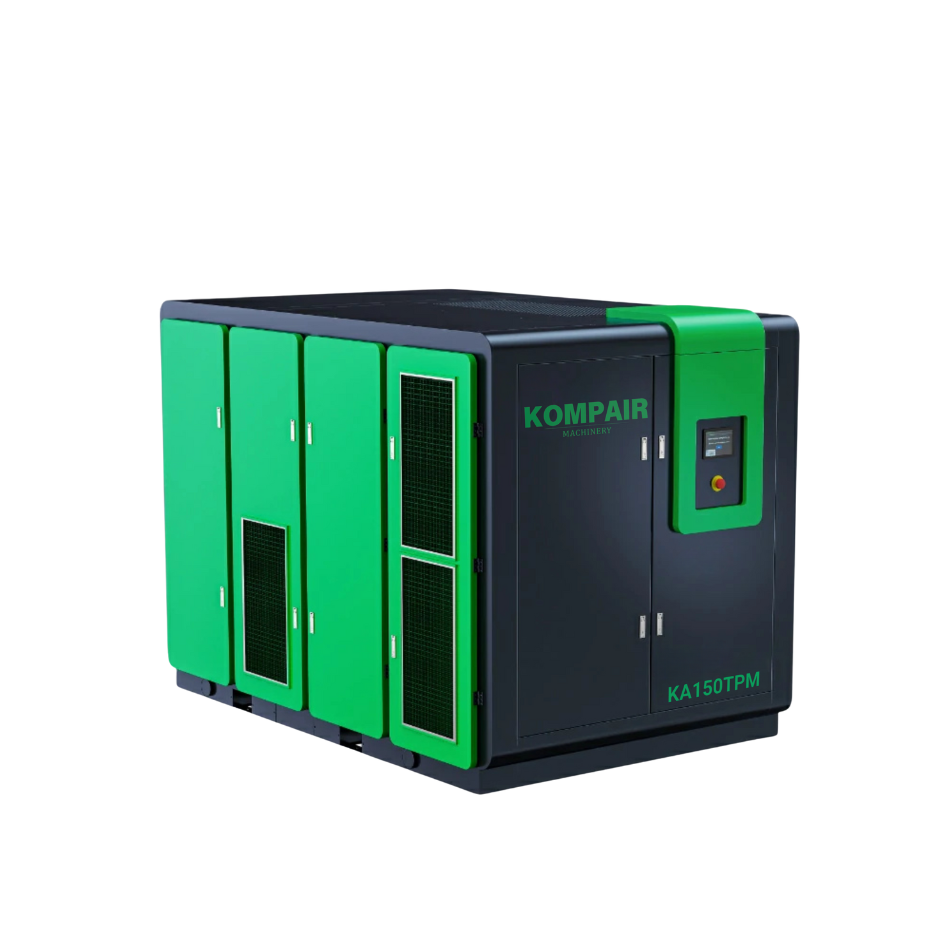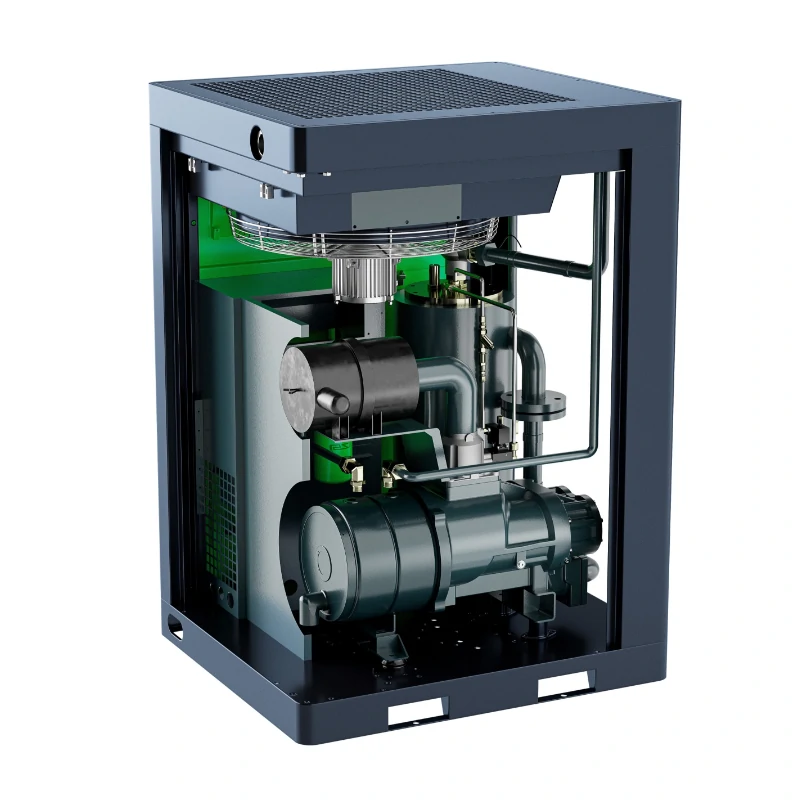
We would like to share our practical experience in selecting a complete compressed air system. Based on your production requirements and specific application, you will need to choose from various essential components.
I. Selecting the Right Compressor Type
The choice of compressor dictates the capacity and air quality for your entire factory.
1. Piston (Reciprocating) Compressors
| Type | Airflow | Pressure | Primary Applications |
| Oil Injected | Low (1,5 m³/min) | 7-20kg/cm³ (Bar) | General industry, workshops, most applications. |
| Oil-Free | Pharmaceuticals, medical, laboratories, food & beverage. |
2. Screw Compressors (Rotary Screw)
| Type | Airflow | Pressure | Primary Applications |
| Oil Injected | Low to High (1 – 100 m³/min) | 7-13kg/cm³ (Bar) | Majority of industrial manufacturing sectors. |
| Oil-Free | Pharmaceuticals, food & beverage, medical, electronics/microchip manufacturing, clean rooms. |
3. High-Pressure Compressors
| Type | Airflow | Pressure | Primary Applications |
| High Pressure | Low to Medium (1 – 12 m³/min) | 30-400kg/cm³ (Bar) | PET bottle blowing, plastic product molding, marine vessels, gas filling/transfer, hydroelectric power. |
II. Sizing the Screw Air Compressor
Among the air compressor types mentioned above, the screw air compressor is currently the backbone of most production lines. Therefore, in this post, we will provide a detailed analysis on how to accurately size these machines.
Common Air compressor Selection Criteria
- Air compressor selection can be referenced from factories of similar scale and production capacity, where compressors with equivalent power, pressure, and airflow ratings are commonly used.
- Calculate the total air consumption of all pneumatic equipment, then multiply by a safety factor of 1.2. This factor accounts for potential airflow losses due to system leakage.
- The technical consultant will then determine and recommend the appropriate compressor specifications accordingly.
Technical Sizing Table: Compressor, Electrical, and Piping
Once the compressor capacity is determined, it is crucial to select the appropriate piping, electrical cables, and circuit breakers (MCBs) for safe and efficient operation.
| Power (kW) | Flow Rate (m³/min @ 7 bar) | Circuit Breaker (3-Phase) | Electrical cable | Outlet Pipe Diameter (mm) |
| 7.5 kW | 1.2 -1.3 | 30 A | 3.5 – 5.5 | Ø20 |
| 11 kW | ~ 1.8 | 50 A | 5.5 – 8 | Ø25 |
| 15 kW | ~ 2.5 | 60 A | 8 – 14 | Ø25 |
| 22 kW | ~ 3.9 | 100 A | 14 – 50 | Ø30 |
| 37 kW | ~ 6.5 | 150 A | 38 – 100 | Ø40 |
| 55 kW | ~ 9.5 | 200 A | 38 – 100 | Ø40 |
| 75 kW | ~ 13 | 225 A | 38 – 100 | Ø50 |
| 100 kW | ~ 18 | 300 A | 100 – 150 | Ø60 |
III. Air Treatment Equipment Selection
Treated compressed air is essential for protecting downstream tools and ensuring product quality.
1. Air Dryer Selection
There are two main types of air dryers, chosen based on the required Pressure Dew Point (PDP):
| Dryer Type | Required Dew Point (PDP) | Recommended Application |
| Refrigerated Dryer | 3ºC to 10ºC | When high air dryness is not critical (general factory use). |
| Desiccant Dryer | -39ºC to -61ºC | When absolutely dry air is required (e.g., critical processes, sensitive applications). Note: The high cost limits widespread use. |
Note for Refrigerated Dryers: Always select a dryer with a capacity at least 20% higher than the screw compressor’s flow rate. This compensates for air loss due to the dryer’s condensate discharge.
2. Compressed Air Filter System
Filter configuration depends on the air quality requirement. Here are five common options:
If clean and dry compressed air quality is not required, the air filtration system may be omitted from the pipeline installation.
1. One Oil-Water Filter (5µm) installed downstream of the piping.
2. Two-Stage Filtration (Most Common):
- Pre-filter (1µm): Removes bulk dust and water.
- After-filter (0.01µm): Removes fine particles, water, and oil aerosols.
3. Three-Stage Filtration: including Oil-Water Filter (5µm), Pre-filter (1µm), After-filter (0.01µm).
4. Four-Stage Filtration:
- Including Oil-Water Filter (5µm), Pre-filter (1µm), After-filter (0.01µm), and Activated Carbon Micro-Oil Mist Filter (0.003µm).
- Application: Highly recommended for industries with strict compressed air quality standards, such as pharmaceuticals, food & beverage, and clean rooms.
Selection Rule: Select air filters based on the system’s compressed air airflow rate and working pressure should be considered (Recommend: A filter capacity of 1.2 or higher).
IV. Sizing the Air Receiver Tank
The air receiver tank stores compressed air, stabilizes pressure, and compensates for pressure fluctuations in the system. Our experience dictates the following sizing based on compressor power:
| Compressor Power (kW) | Recommend Air Receiver Volume |
| 7.5 – 15 kW | 200 – 500 L |
| 22 – 30 kW | 500 – 800 L |
| 37 – 45 kW | 700 – 1,000 L |
| 55 – 65 kW | 1,000 – 2,000 L |
| 75 – 85 kW | 2,000 – 3,000 L |
V. Conclusion
Selecting and sizing a complete compressed air is a decision that profoundly impacts your operational efficiency, product quality, and long-term energy costs.
By carefully choosing the complete compressed air system for your specific application, you are not only purchasing machinery, but also investing in a reliable production backbone.
Ready to build a compressed air system that runs efficiently? Please do not hesitate to contact us for the best consultation.